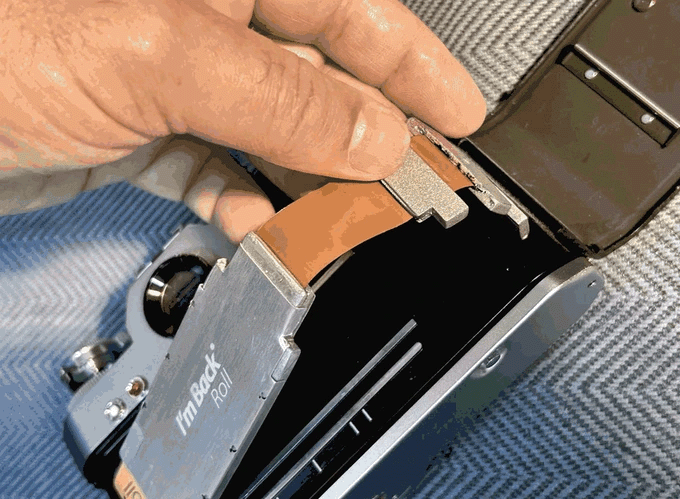
Right up front I'll admit to a bias: the purpose of this Web site is to help those who own a Nikon film SLR understand and use it. Today's news doesn't exactly fall into that category, but I've been asked about it, so I thought I'd post my thoughts. The idea of converting a film SLR into a digital camera goes well back into the late 1980's. After all, that's what the original Kodak modifications of film SLRs (the DSC models that launched in 1991) were: take an existing film SLR and somehow bolt on what was necessary to have it take photographs digitally. Kodak's original DSC models were heavily modified Nikon (or Canon) SLRs that had huge electronic chins clipped onto the bottom of the body, plus a lot of internal modifications, as well. The Nikon D1 in 1999, though, is pretty much what kicked off the DSLR era, as it was a complete redesign that didn't have the kludge factor(s) of all the earlier attempts. The D1 was from the get go designed as digital, yet respected all of Nikon's legacy design and UX (user experience). It felt like a pro SLR, only it didn't use film. From the moment the D1 went viral and proved that DSLRs could be in demand, the idea of users converting their film SLRs to digital came into play. After all, who wanted to buy another camera? Moreover, if the digital conversion kit could be made to cost as little as a few dozen rolls of film and processing, there might even be a cost incentive to converting your existing film camera instead of buying one of those new, very expensive DSLRs (the Nikon D100 was US$2100 at introduction in 2002). I know of at least three attempts that were made early on in the digital era to create a user conversion kit, when it made the most sense. All ultimately failed, for a variety of reasons. The I'm Back folk popped up at Photokina 2016, where they won a show award for their film conversion prototype. They've been tinkering ever since, and today we basically have "I'm Back is Back." With a Kickstarter campaign to help get them from prototype to production. That last line is key: many of the reports about I'm Back seem to imply that it's a done deal and ready to buy. From what I can see from their Kickstarter campaign, they still have a ways to go, though they have demonstrated a prototype that fits entirely within a film camera, much like a roll of film. Even if I'm Back Roll—that's the product name—makes it to production, it won't be a panacea. First, it's an APS-C image sensor (Sony IMX571, which is 26mp). It's ironic that the hero video in their Kickstarter campaign uses a Nikonos as an example (Nikon's underwater film camera). Because of the way water refracts light (1.33x), it has an impact on focal length. You'd typically use a 28mm (or wider) lens on a Nikonos. Using an APS-C sensor, of course, cuts the field of view by 1.5x, making it less useful to make a digital conversion for existing Nikonos bodies. Second, it doesn't appear that I'm Back has fully solved the integration issue. The way they describe working with the I'm Back Roll is this: press a button on the Bluetooth remote they supply to activate the image sensor, and within two seconds press the camera's shutter release. The reason for the two-second timeout appears to be that a very small battery is integrated into the part that slots into where the film cassette would be in the camera. That small battery has to power the image sensor, processing electronics, and the internal memory for the device. So I guess my reaction is this: you're going to still be working at the slower pace that film SLRs require you to, you're now going to have to pull the I'm Back Roll out of the camera to recharge it after a few (unspecified number) photos are taken. You still won't see your results until you download them to your computer. And you're going to have to anticipate the 1.5x crop that's implied. Thus I don't grok any reason I'd want I'm Back Roll. Their header video plays off the nostalgia theme (you're resurrecting the past), but I can do that by just putting a roll of film into my film camera and taking photos. Let's see, at US$10 roll, that's 50 rolls of photos I could be taking while waiting for my US$500 copy of I'm Back Roll to eventually appear. If I were a shark in the Shark Tank, I'd be saying "I'm Out."