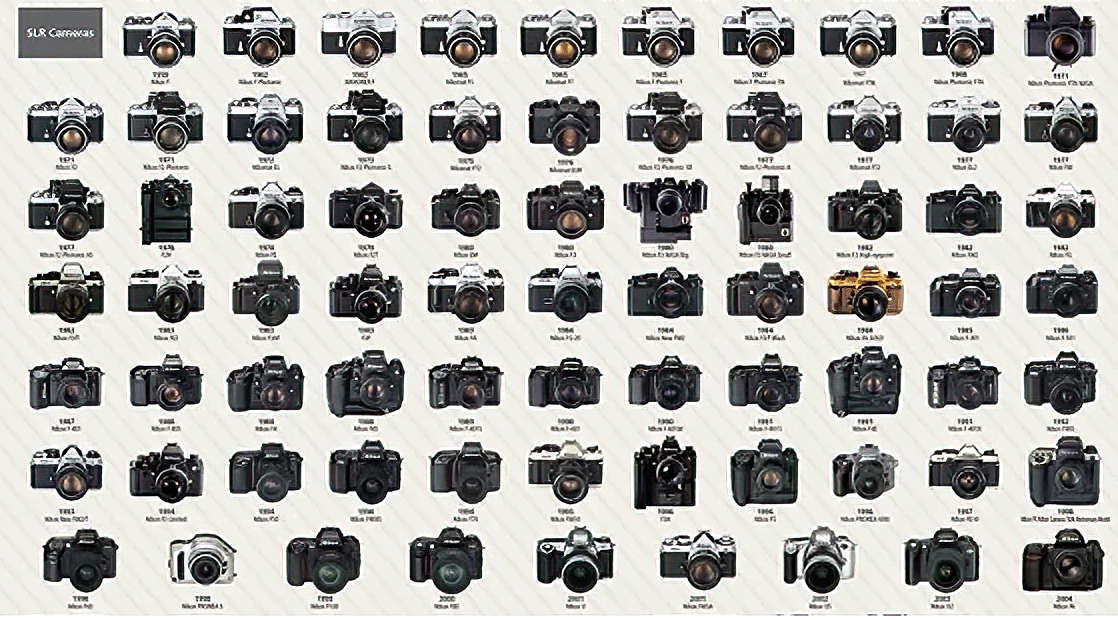
It's 2026. Nikon stopped making film SLRs alomst twenty years ago, so if you don't already have a Nikon film SLR, you have to buy one on the used market. Thus I thought it worthwhile on publishing the new filmbodies site to take a look at some sources of used cameras (keh.com, mpb.com, ebay.com) and see what the prevailing winds are. But first I'd like to remind people that some Nikons are collectables and therefore expensive (e.g. FM3A, F3/titanium, etc.). Those are probably not the cameras you want to invest in just to start running spools of film through. You risk eroding the value they currently have as a collectable doing that. So I say leave the collectibles to the collectors. Meanwhile, some tech has aged out. Early Nikkormat (or Nikomat in Japan) cameras used batteries for their meter that are not readily available any more. The old F2 Photomic meter also turns out to be not very reliable as it ages. Thus, our first stop is advice on the cameras I'd still seek out on the used market if you're looking for something decent to use regularly. That list is now commendably short: FM2n, F4s, N80, F100, and F6. These are reliable bodies, and they're listed in order of sophistication. I'd have no qualms using any of these to explore the analog side of photography today. On the flip side, there are some bodies you should probably avoid. I'd tend to include the all-electronic, battery hog, and sometimes finicky F5 in that list, though I wouldn't out-and-out avoid it. Basically anything from the older era (N6006, N8008, N90s) needs to be available at the right price to warrant your attention. Lower end cameras from the most current era (N60, N65, N75) would need to be in proven excellent shape for me to bite on them. Anything from the oldest era (EM, Nikkormat, FG, etc.) really has to be under US$100 to consider, and even then it needs to be in very good or better shape and proven to work first. So skip all these bodies unless someone dangles an overly compelling price at you. Next, I'll point to two specific cameras you should probably target in your search for a used body, one manual, one electronic. The manual one would be any FM (FM, FM2, FM2n). The eldest of those can run as little as US$100 for a very good copy, while the FM2 models in excellent shape can go for US$300. These are sturdy, reliable cameras, mostly because they don't have a lot of electronics and they were built in a time when precision and durability were a key attribute (Nikon mostly wanted to sell lenses back then). On the electronic side, things get more expensive. I wouldn't turn down an N80 in excellent shape, and those can be remarkably inexpensive (US$100-150). However, I'd tend to target the F100, which can run from US$250 to US$400 these days. The F100 is a solid, modern camera with plenty of feature depth and performance (and besides, you could buy my book to learn more about it ;~). The tricky part is this: whichever body you buy should also dictate the lenses you purchase, too. I'd match AI-S Nikkors with an FM2n, for instance, because the body doesn't have autofocus, and you can often find these lenses at fairly low prices. With the F100, I'd put AF-D and AF-S lenses on it. If you look around, you can find plenty of deals on these autofocus lenses. Moreover, there's a huge variety and a depth of supply available at the moment, the latter from all the folk trading in F-mount gear for Z-mount. Just as in the film era itself, the expensive part of exploring analog photography today is not going to be the camera, it's going to be film and processing. A good rule of thumb to use right now is that it's going to cost you about one dollar a photo (US$10 for the film, US$20 for the processing and 4x6 print) for color negative film, more for slide (reversal) film. Thus, by the time you use ten rolls of film you're already probably spending more on film than for the camera body. This is one of the reasons why I single out those two somewhat higher priced cameras to target (FM2 and F100): if you're going to be spending so much on film and processing you really don't want to be dealing with finicky bodies, bodies with weird user interfaces (N70/F70), or ones that don't hold up as well to continued use.