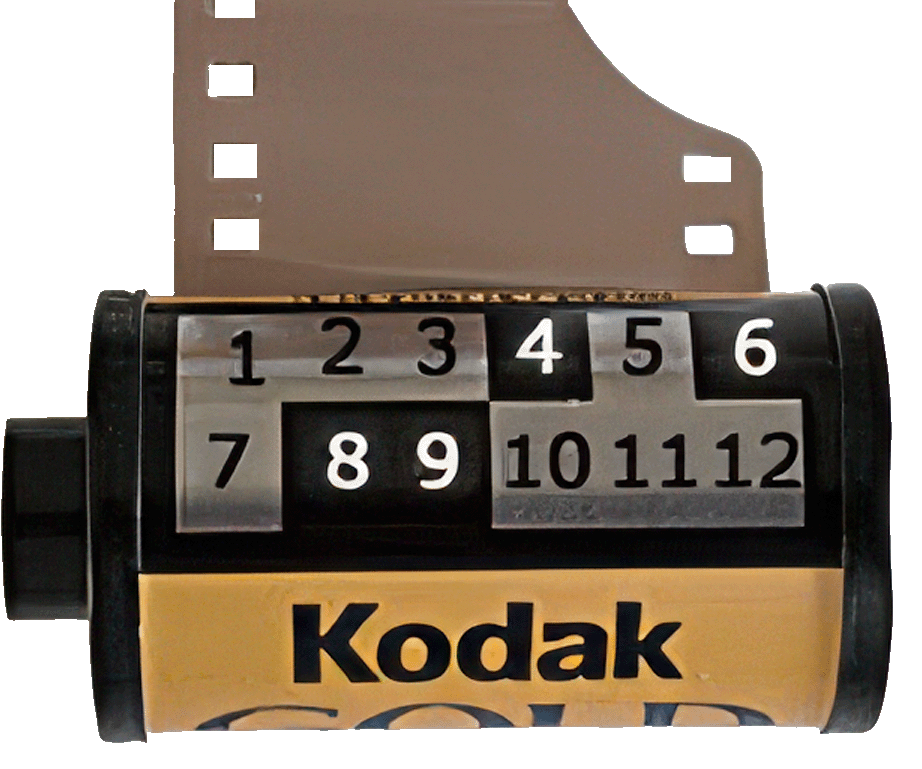
Deciphering Film Cassettes
Just what do those metal strips on your film cassetes do?
One interesting question that I get asked from time to time is how to manually encode DX information on film cassettes. I documented this in the original manuscript for my Nikon Field Guide, but unfortunately it was one of the things that had to be left out due to page count limitations. You can find a set of foils that can be used to change DX coding on Amazon here: (hint: search for “DX Coded Film Labels”),, but I have rarely seen the information you need to make your modifications documented.
DX coding is specified by an international standard: ANSI/NAPM Standard IT1.14:1994. Refer to the picture of the film cassette, above, for the 12 positions where conductive metal strips can be applied.
- Positions 1 and 7 on the left are always set to conduct (i.e., are metallic areas). They are used for alignment purposes.
- The ISO value of the film is indicated by positions 2-6 in the top row. Film speeds from ISO 25 to 5000 can be encoded.
- The number of exposures are indicated by positions 8-10 in the bottom row. Note that many Nikon bodies can actually get an extra exposure off most film when loaded correctly.
- Finally, the exposure latitude is indicated by positions 11-12 in the bottom row. Latitude is used by some automatic processors for print film, but is not relevant to slide film (note that the Kodak Gold film in the above photo shows that it has +3 to -1 stop latitude).
See the above picture for positions; see the tables below to decode. Remember, the conductive areas are reflective silver, the other areas are non-conductive and usually black (a few manufacturers use a different base color on some cassettes).