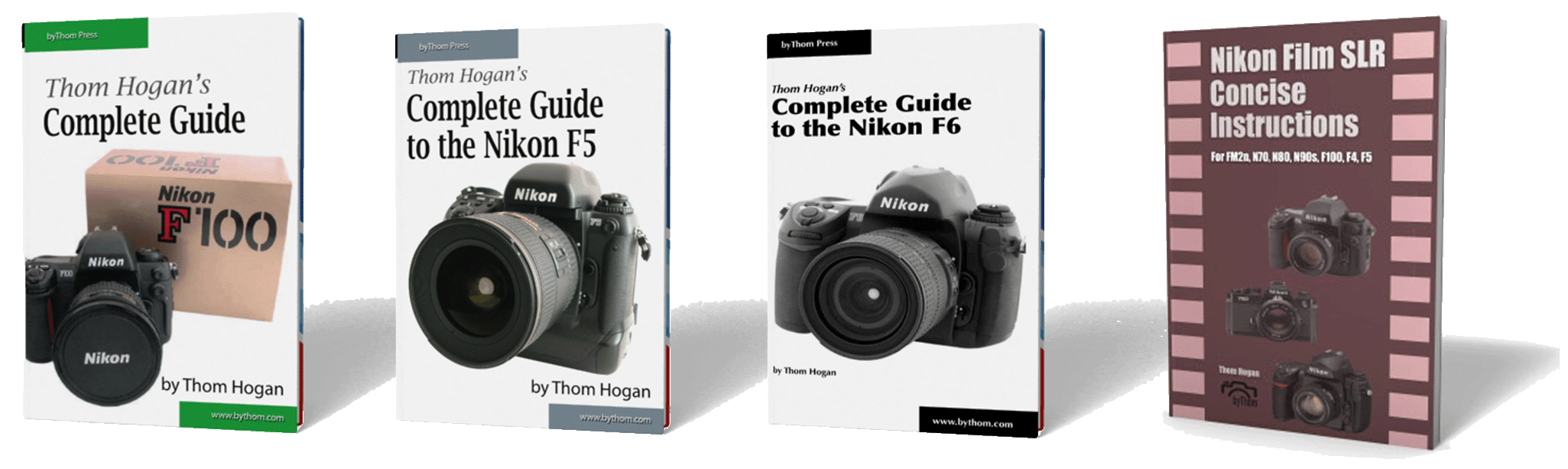
Complete Guide to the Nikon F100
Nikon’s best ever prosumer film SLR borrowed a lot from the F5, which makes it a fairly complex camera to learn and use. Many F5 users transitioned to this camera because it was smaller and lighter, but still did pretty much everything that the F5 did. Of course, like the F5, there’s a lot of complexity to the F100, as well. This book explains it all.
Complete Guide to the Nikon F5
The F5 was the first of Nikon's professional cameras to go “all electronic.” This was both good news and bad, as the capabilities of the F5 far exceed the F4 that preceded it, but this didn’t happen without heavy battery use and a lot of complexity. The basic body design of the F5 is still seen in Nikon’s latest Z9 mirrorless pro camera, so a lot of foundational work appears in the F5, as well. You’ll want this book to explain all that, which it does clearly and in detail.
Complete Guide to the Nikon F6
Nikon surprised everyone by creating their best ever film SLR early in the DSLR era when they were dropping all their film support. Because the F6 was based on the D2h, it brings even more advances in the metering, focus, and other systems of the camera, and is considered the most refined film SLR made. There’s even a way to record information about the images you take! This book explains every feature of the F6 and will get you up to speed quickly.
Nikon Film SLRs Concise Instructions
This free book is derived from Thom’s Nikon Field Guide, now out of print. In Nikon Film SLRs Concise Instructions you’ll find information about how to use the following Nikon SLR cameras: FM2n, N60 (F60), N70 (F70), N90s (F90x), F100, F4, and F5. While the level of information in this free book isn’t close to that in the Complete Guide series, the goal for this book was to preserve and disseminate clear information about how to use many of Nikon’s most important film SLR bodies, as manuals and books for those cameras are becoming harder to find.